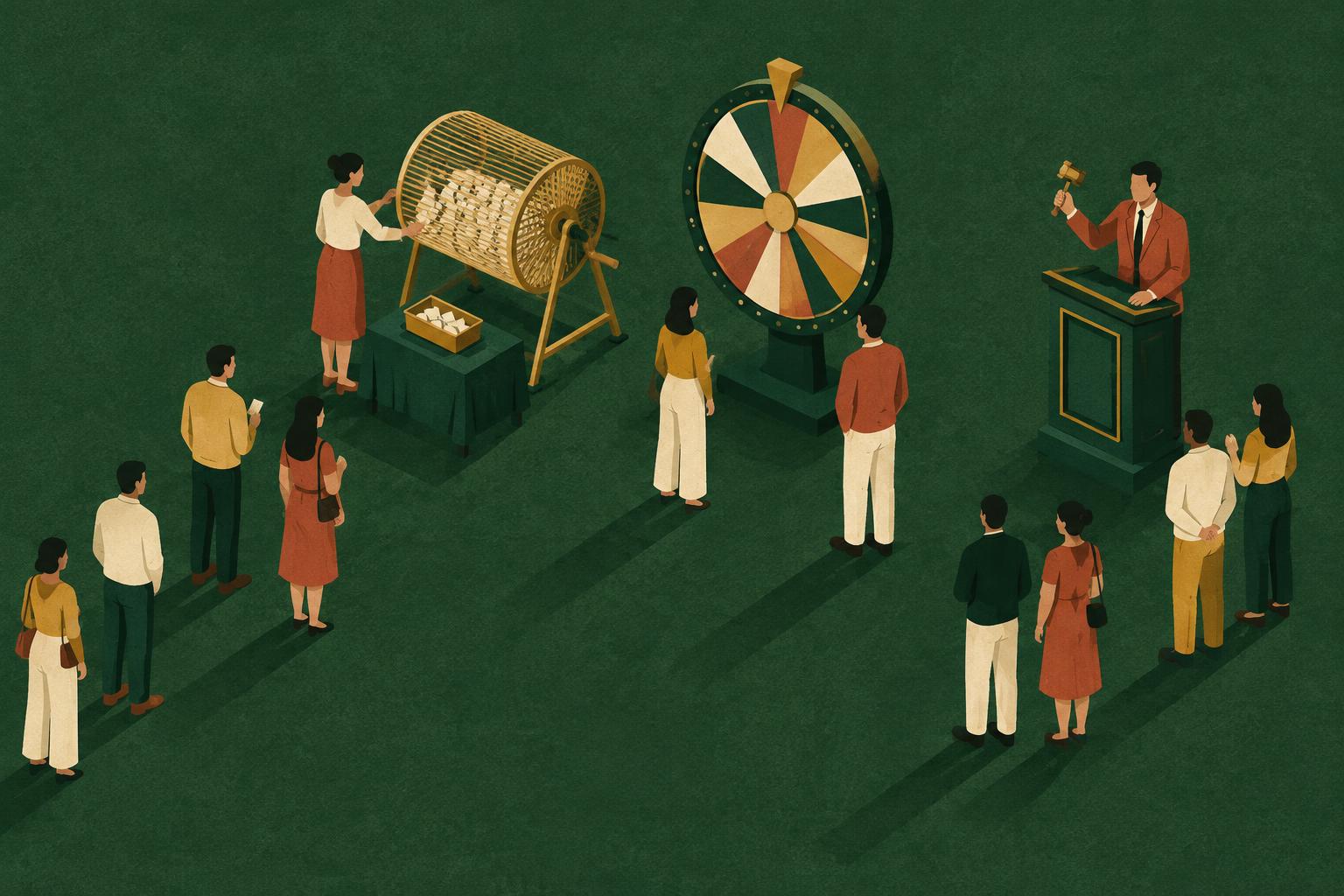
In short: A raffle and a lottery are games of chance: luck decides who wins. In Belgium, since 2022, an association recognised by the municipality may hold up to four raffles a year for a social or charitable purpose; in the Netherlands you apply to the municipality for a permit when the prize money stays under €4,500. In an auction the highest bid decides, not chance, so lottery rules do not apply. WeGlow Auctions is free for your organisation.
The short answer
If you want to raise money with prizes, you choose between chance and bidding. A raffle or lottery is a game of chance and needs permission or a permit in Belgium and the Netherlands. An auction is not a game of chance: the highest bidder wins, so lottery rules do not apply.
| Raffle or lottery | Auction | |
|---|---|---|
| Who wins | Chance | The highest bid |
| Belgium | Permission through the municipality, up to 4 times a year | No lottery rules |
| Netherlands | Permit from the municipality or the Gambling Authority | No lottery rules |
The difference between chance and bidding
The distinction is simple: if chance decides, it is a game of chance, such as a raffle, lottery or bingo. If the highest bid decides, it is an auction. Games of chance have strict rules; an auction does not fall under them.
In a raffle someone buys a ticket and hopes for a prize: chance decides. In an auction the bidder decides what a lot is worth to them, and the highest bid wins. That difference decides which rules apply. Bingo is also a game of chance, with its own rules.
Belgium: raffles since 2022
In Belgium, since 2022, an association recognised by the municipality may hold up to four raffles a year for a social or charitable purpose. The rules are in the lottery law of 1851, amended in 2022, and a Royal Decree of 13 September 2023.
Raffles do not fall under the Gambling Act but under the Law of 31 December 1851 on lotteries, which was amended in 2022 to legalise local raffles; the change applies since 20 July 2022. The detailed rules are in a Royal Decree of 13 September 2023. According to the Gaming Commission, an association recognised by the College of Mayor and Aldermen may hold up to four raffles a year at municipal level, for a social or charitable purpose. The National Lottery can authorise larger lotteries.
Limits on prizes or ticket prices are in the Royal Decree. Ask your municipality how recognition works before you plan a raffle.
Bingo in Belgium
According to the Flemish Tax Administration (in Dutch), bingo is no longer a lottery but it is a game of chance. In principle it needs a licence or permission from the Gaming Commission, unless it falls under the exemption in article 3.3 of the Gambling Act. The municipality may also require its own permission. If you plan a bingo night, check beforehand.
The Netherlands: a permit for every lottery
In the Netherlands every charity lottery needs a permit: from the municipality under €4,500 in prize money, from the Gambling Authority above that. Tickets for a charity lottery are not tax-deductible.
In the Netherlands you may only ask money for a lottery for a public interest. According to Ondernemersplein (in Dutch), you apply to the municipality for a permit when the prize money stays under €4,500; above that you apply to the Gambling Authority for a one-off lottery permit. Tickets are also not a deductible donation: the Dutch Tax Administration states that tickets for a charity lottery may not be deducted.
Raffle and auction side by side
In a raffle and a lottery chance decides, in an auction the highest bid. That is why lottery rules do not apply to an auction, and none of the three gives the right to a tax certificate.
| Raffle | Lottery | Auction | |
|---|---|---|---|
| Who wins | Chance | Chance | Highest bid |
| Belgium | Recognised association, up to 4 times a year | Larger lotteries through the National Lottery | No lottery rules |
| Netherlands | Municipal permit under €4,500 in prize money | Gambling Authority above €4,500 | No lottery rules |
| Tax certificate | No | No | No, the bid is not a donation |
Why many organisations choose an auction
An auction needs no lottery permit and lets bidders decide what a lot is worth. For strong lots that often raises more than tickets. In one evening you can combine both: the raffle for small prizes, the auction for the top lots.
An auction needs no lottery permit, and the winner decides what a lot is worth. That is why strong lots often raise more than the price of a ticket. A raffle and an auction do combine well in one evening: small prizes in the raffle, the strongest lots in the auction. How such an evening runs is in our guide to a silent auction.
The most common mistakes
- A raffle without permission. Check with your municipality first.
- A lottery for a private purpose. In the Netherlands that is not allowed.
- Presenting tickets as a donation. They are not deductible.
- An auction with hidden chance. A "mystery lot" where chance decides turns it into a game of chance.
What you need
For a raffle: permission through your municipality in Belgium, or a permit in the Netherlands. For an auction: lots, a link and a way to collect payments.
On WeGlow Auctions you set up an auction for free; the winner pays the 5% buyer's premium: a bid of €100 costs the winner €105. How an auction runs is in our guide to running a charity auction.
Frequently asked questions
May a non-profit hold a raffle in Belgium?
Yes, if the association is recognised by the College of Mayor and Aldermen: up to four times a year, at municipal level, for a social or charitable purpose. Ask your municipality. An auction on WeGlow Auctions does not fall under those rules.
How many raffles a year may I hold?
In Belgium up to four a year at municipal level, under the Royal Decree of 13 September 2023. In the Netherlands every lottery needs its own permit. For an auction on WeGlow Auctions there is no such limit.
Do I need a permit for an auction?
Not under lottery rules: in an auction the highest bid decides, not chance. Other rules, such as on advertising at schools, can still apply. On WeGlow Auctions you set up an auction for free.
What is the difference between a raffle and a lottery?
Both are games of chance. A raffle is a small, local lottery with prizes in kind; larger lotteries fall under the National Lottery in Belgium and under the Gambling Authority above €4,500 in prize money in the Netherlands. WeGlow Auctions runs no raffles or lotteries, only auctions.
Are raffle tickets tax-deductible?
No. The Dutch Tax Administration states that charity lottery tickets are not deductible, and in Belgium a ticket is not a donation without anything in return. A bid on WeGlow Auctions is not a deductible donation either.
Prefer an auction?
Create an event, add your lots and share the link. Free for your organisation, with no lottery permit.
Free for organisations. The winner pays a 5% buyer's premium on top of the winning bid.
Sources: Gaming Commission, Flemish Tax Administration, Ondernemersplein and Dutch Tax Administration. Checked on 12 November 2026. This is not legal advice. Updated: